Loading…
Program Purpose
Today, video is a prevalent element of everyday life in both personal and professional settings. This has led to a growing demand for those who have artistic talent and technical ability to create engaging video content, visual effects, and motion graphics.
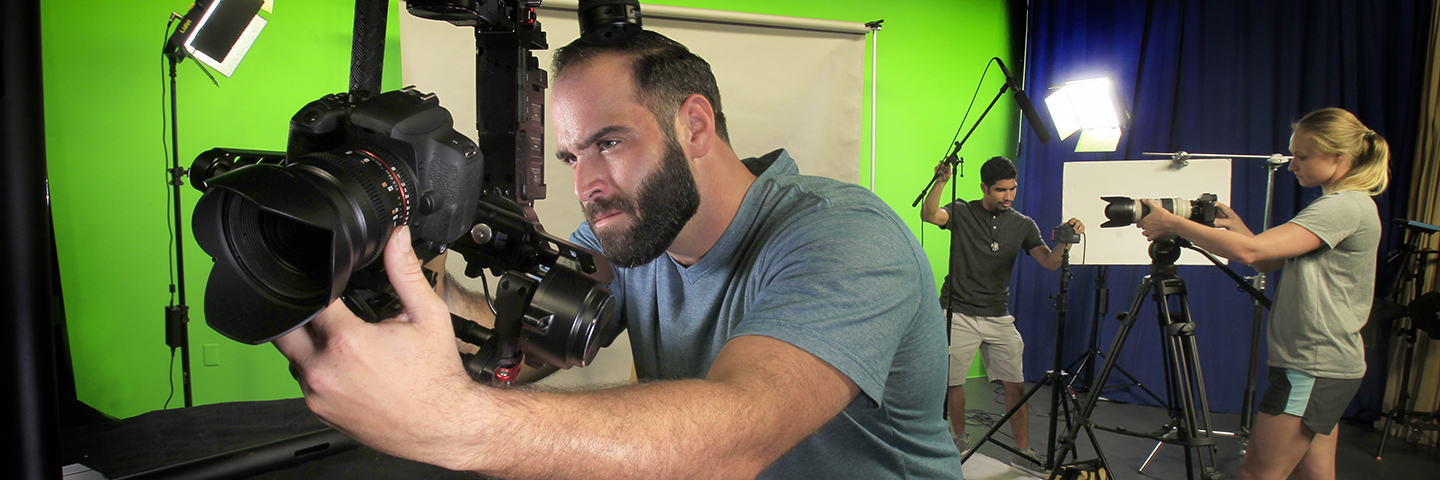
The Wilmington University Bachelor's of Science in Video and Film Production provides students with a strong foundation in the core skills for all stages of production, geared towards filmmaking, news, corporate, educational, or entertainment. Students will explore real-world production concepts under the direction of expert faculty with extensive field experience and gain additional skills in graphic design, animation, compositing, and sound.
Program Competencies
Program of Study
The Video and Film Production Bachelor's of Science is for students wishing to pursue careers in television, film, motion graphics, visual effects, and related fields. Students will have a strong core skill set applicable to any video work ranging from news, film, television, commercials, drama, action, corporate, or documentary applications, then allowing the students to focus on their area of interest through the concentrations.
Cooperative Education Option
The Cooperative Education option is an alternative to the VFP 487 - Video and Film Production Senior Project and VFP 495 - Digital Media Internship. Each co-op assignment is one semester long and normally the two co-op assignments span two consecutive semesters with the same employer.
Experiential Learning
Experiential Learning at Wilmington University takes a 360° approach to applied education. Whether you bring significant professional experience and pursue Credit for Prior Learning (CPL), or you complete a Work-Integrated Learning (WIL) experience such as an internship or cooperative education placement embedded within your academic program, these opportunities provide meaningful pathways toward completing your degree.
Minimum Grade Policy
The College of Business and Technology sets a required minimum grade of "C-" for program core courses. Students earning a grade lower than "C-" in a core course must repeat the course.
CTA 210 Intro to Technology
DSN 105 Visual Communication
ECO 105 Fundamentals of Economics
ENG 121 English Composition I
ENG 122 English Composition II
ENG 131 Public Speaking
ENG 360 Creative Writing
HIS 381 Contemporary Global Issues
MAT 205 Introductory Survey of Mathematics
PHI 100 Introduction to Critical Thinking
PSY 101 Introduction to Psychology
VFP 313 Aesthetics of Film
Natural Science
ANI 201 Fundamentals of Motion Graphics
DFM 200 Introduction to Digital Film-Making
DFM 300 Directing Digital Films
DFM 350 Digital Film-Making II
DSN 210 Basic Photoshop
DSN 220 Concept Development
VFP 100 Camera and Cinematography
VFP 101 Introduction to Sound
VFP 200 Adv Camera and Cinematography
VFP 202 Sound Editing and Design
VFP 203 Intro to Non-Linear Editing
VFP 222 Story Design Methods
VFP 301 Lighting for Production I
VFP 302 Lighting for Production II
VFP 350 Journalism in Practice
VFP 400 On Location Production Techniques
VFP 401 Producing the Documentary
VFP 402 Studio Production Techniques
VFP 423 Advanced Non-Linear Editing
VFP 487 Video & Film Production Senior Project
VFP 495 Digital Media Internship
OR
VFP 489 Experiential Learning in Video and Film Production
Students should choose a technology certificate to fulfill this elective core. If not pursuing a certificate, students may choose from the following undergraduate courses to fulfill their electives: ANI, CSC, DFM, DSN, GMD, ISM, SEC, TEC, UAV, VFP. Selecting an elective outside of this list will require approval of the Program Chair.
A completion degree is a personalized version of a bachelor's degree created exclusively for students who have completed an associate degree at an accredited institution. Completion degrees are available for most Wilmington University Bachelor of Science degrees. A student who expects to transfer a completed associate degree should communicate with a Wilmington University academic advisor before registering for courses. A transcript with documentation of the conferred degree must be received by Wilmington University to confirm eligibility.
Note that a minimum of 120 combined credits are needed to satisfy the Completion Degree requirements, including both transfer credits and credits earned at Wilmington University.
VFP 330 Aerial Cinematography
CoT Elective
The following courses are prerequisites for a completion degree in Video and Film Production:
VFP 101 Introduction to Audio
Note:
Some courses have prerequisites and should be taken in the correct sequence. If your associate degree is in an academic discipline different than the one you plan to study at Wilmington University, you may be required to take additional courses to ensure your success in your chosen program of study.
This information applies to new students who enter this degree program during the 2026-2027 Academic Year. All enrolled students should log in to MyWilmU Degree Works to view their personalized course and program completion requirements. You may also refer to the academic catalog for the general curriculum for this program from previous academic years.
DESCRIPTION
PREREQUISITES
CROSSLISTING
SYLLABUS